STRIDE
STRIDE is a threat modeling methodology developed by Microsoft. It groups threats into six categories based on the security property they violate. Reviewing each part of a system against these categories provides a structured way to identify common security concerns.
| Category | Description |
|---|---|
| Spoofing | Impersonating a user, service, or system component. |
| Tampering | Modifying data, messages, or system components without authorization. |
| Repudiation | Performing actions that cannot later be proven or attributed because sufficient logging or auditing is missing. |
| Information disclosure | Exposing sensitive information to unauthorized users or systems. |
| Denial of service | Preventing legitimate users from accessing a system or service by exhausting or disrupting its resources. |
| Elevation of privilege | Gaining permissions or capabilities beyond those originally granted, allowing an attacker to perform unauthorized actions. |
Using STRIDE in Lantern
Lantern includes built-in support for applying STRIDE throughout a threat model.
Threats can be linked to one or more STRIDE categories. Lantern uses these relationships to track the threats identified in each category, both for individual elements and across the project as a whole.
Future releases will also support tracking categories that were considered during the assessment, even when no threats were identified.
Element coverage
Each element has its own STRIDE coverage view, showing the categories in which threats have been identified.
 STRIDE element coverage overview of a store
Project coverage
Lantern also provides a project-wide coverage overview, combining the results from all elements in the model.
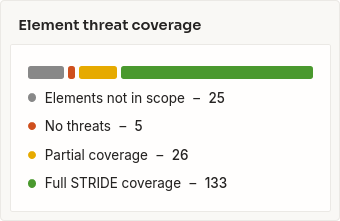 STRIDE coverage overview
Reports
STRIDE classifications and coverage information can also be included in generated reports, making it easier to communicate which threat categories were identified, review coverage across the model, and highlight areas that may require further assessment.
STRIDE coverage by element type
Not every STRIDE category needs to be considered for every element type. Lantern applies only the categories that are relevant to the role an element plays in the system.
| Element type | STRIDE categories |
|---|---|
| Entity | Spoofing, Repudiation |
| Process | Spoofing, Tampering, Repudiation, Information disclosure, Denial of service, Elevation of privilege |
| Flow | Tampering, Information disclosure, Denial of service |
| Store | Tampering, Information disclosure, Denial of service |
| Boundary | Boundaries cannot be linked to threats and therefore do not require category-level review. |
You can still apply any STRIDE category to an element, but only the required categories are used when signalling the element coverage.